

August 15th
A Dutiful Wife. A Foreign Guest. One Weekend.
For seven years, Sneha has run one of Amritsar’s great households flawlessly. Her husband calls her his. He has never once asked what she wants.
Then a Commonwealth delegation arrives for India’s Independence Day, and among them is Marcus — a widowed British official who asks her exactly that. And waits for the answer.
One afternoon in the walled city. One question at a dhaba table. One card with a room number, pressed into her hand — call if you need anything.
When her husband leaves for the weekend and the house falls empty for the first time in her marriage, Sneha stands before the mirror, takes off her mangalsutra, and makes a declaration.
A slow-burn, explicit novelette of desire, dignity, and one woman’s private independence — set against the rich cultural background, monuments, and history of Amritsar in August.
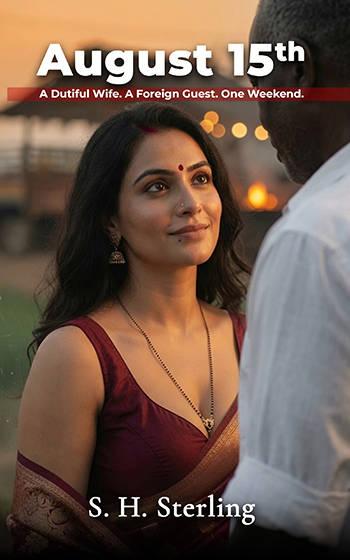
A glimpse beneath the sheets…
The house was completely, entirely empty for the first time in my marriage. Not just quiet — empty. No in-laws, no Aanya, no Ravi. The staff had gone home hours ago. It was their Independence Day too. Just the house and its breathing and every one of its rooms at my disposal, which should have felt like freedom and instead felt like standing in the centre of a very large question I had been declining to answer for seven years.
I tried to eat. I made myself a plate: leftovers from yesterday’s lunch, the dal makhani, some roti. I sat at the dining table. The food was fine. I could not taste it.
I burned the roti I was trying to warm. I turned the stove off and sat back down.
I reached inside my blouse and took out the card Marcus had given me in the hotel lobby — call me if you need anything, he had said. I set it on the table in front of me. Hotel name, room number in his handwriting, his mobile number. I picked it up. I turned it over in my fingers — the weight of the stock, the ink — and the decision, I understood, was already further along than I had been admitting, and not because Ravi had asked me to take the initiative. I reached for the phone, then set it back on the table, face down.
I was crying when the phone rang. I didn’t know I had been crying until the phone started buzzing. I turned it around. Ravi’s name on the screen. I wiped my face before answering, which was a reflex I noticed with the part of my brain that noted things even when the rest of me was occupied.
“Just calling to check,” he said. Behind him: music, voices, crowd sounds that come from a private room. A woman’s voice very close to the phone, close enough that she was in contact with him, the proximity unmistakeable. A sound that was the beginning of kissing.
“Ravi —”
“Don’t wait up,” he said. His voice already somewhere else, already in the room he was in and not the call he was on. “I won’t be back until Sunday night. Maybe Monday. Tell the staff I’ll call.”
The line went.
I sat with the phone in my hand.
The card was still in my hand. I had not put it down.
***
I showered. I washed my hair properly and stood in the steam for longer than was efficient.
In the bedroom, I looked at my wardrobe.
I chose a churidar-kurta, deep blue, simple neckline, nothing I was choosing to impress anyone. I held it up. Then I put it back. Chose another, the same register, but the fabric sat with a little more weight — present without being sheer — the neckline sitting differently, a small and undeniable difference. I had bought it a year ago and not worn it.
I looked at myself in the full-length mirror. The churidar, my hair damp and loose, no jewellery but the mangalsutra and nose stud that I never take off.
And then, for the first time in longer than I could account for, I looked. A woman of thirty-five looked back. Slim — slimmer than the saree ever admitted, the saree being an instrument of dignity rather than truth — with the fullness above the waist that seven years of tailored blouses had been instructed to contain rather than announce. The waist itself, which the churidar found and held. Skin the colour of milky chai, darker at the forearms where the kitchen and the school gate had had their say. Hair past my shoulder blades, damp and heavy, the one vanity I had never surrendered. My mother’s mouth. And below my lower lip, to the right, the mole — the dark point I had spent my twenties hating. The aunties had called it a nazar ka teeka, God’s own thumbprint against the evil eye, which is the kind thing people say about a flaw. Ravi had not mentioned it once in seven years, which was its own information. I looked at it now and did not cover it with my hand. Beside my nostril, the small diamond stud caught the light — the one piece I had chosen for myself, before the marriage, and kept. Dark eyes, tired at the edges and not tired anywhere else. I stood there and took inventory of a body that had spent seven years as household equipment and an instrument of convenience.
I looked for Ravi’s wife and Aanya’s Mama, and a woman looked back. It was an introduction. For seven years I hadn’t met her. It was time to meet her now.
I reached up and took the mangalsutra off.
I left.
Continue the story in August 15th.
Available now.
A little more spice — on me — for my lovers
This part is for my lovers only.
Sign up, sweetheart — it’s free, and I don’t bite. Unless asked 😉
All images are AI generated and do not depict any real person.